

The ISO 27001 Lead Auditor exam is not only a memory test. Candidates need to understand ISO/IEC 27001:2022, but they also need to think like auditors: define criteria, collect evidence, test implementation, judge findings, and communicate conclusions professionally.
A good preparation strategy therefore needs two tracks. First, build the foundation: clauses, risk, SoA, Annex A, audit principles, and audit process. Second, practise applying those concepts in scenarios where the correct answer depends on audit judgement.
Start with the exam format
The CQI and IRCA learner guide describes the Lead Auditor online exam as a 1 hour 45 minute exam with 40 questions. It also shows five content areas: management system concepts, audit responsibilities, planning the audit, conducting the audit, and reporting or closing out the audit.
The later sections usually take more time because they include scenarios. That is why a candidate who spends too long on early definition questions can run short of time when audit judgement is needed most.
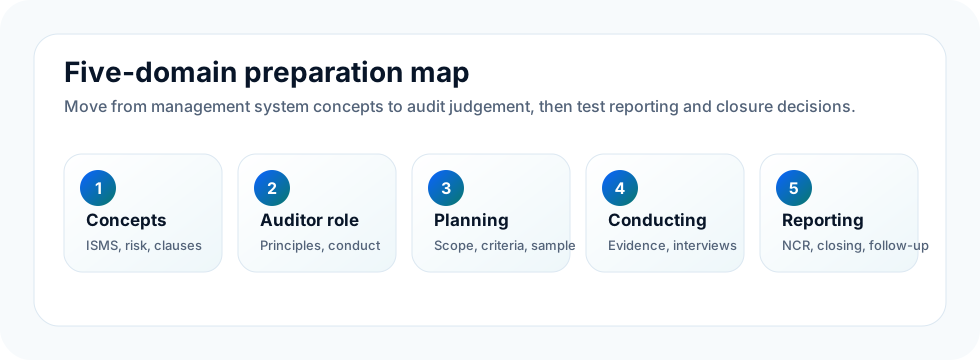
The five-domain study plan
Concepts and principles
Study management system concepts, ISO 27001 clauses, ISMS scope, risk-based thinking, CIA, PDCA, and continual improvement.
Audit responsibilities
Learn audit principles, audit types, independence, confidentiality, competence, auditor behaviour, and role boundaries.
Planning the audit
Practise objective, scope, criteria, audit plan, sampling, Stage 1 readiness, logistics, and audit programme thinking.
Conducting the audit
Focus on interviews, observation, audit trails, sampling, objective evidence, difficult situations, and finding development.
Reporting and closing
Master NCR wording, audit reports, closing meetings, corrective action review, follow-up, and effectiveness evidence.
A practical weekly study sequence
Start with the KISCyber study documents in the same order as the exam domains. This avoids jumping into practice papers before the concepts are stable.
- Foundation day: revise ISO 27000 terms, ISO/IEC 27001 clauses, scope, interested parties, ISMS processes, and risk language.
- Risk day: study risk assessment, treatment, residual risk, Statement of Applicability, and Annex A control selection.
- Audit process day: review ISO 19011-style audit concepts, audit programme, audit plan, audit trails, sampling, and auditor behaviour.
- Scenario day: practise conducting-audit questions, interview choices, evidence selection, and difficult audit situations.
- Reporting day: write NCRs using requirement, evidence, problem, and location. Review correction vs corrective action.
- Timed paper day: complete one full practice set without pausing and analyse section-wise results.
Use the audit answer method
When a scenario looks confusing, slow down and identify the audit structure. Most wrong answers fail because they skip evidence, go outside scope, give consultancy advice, or jump directly to a conclusion.
Use this mental checklist:
- Criteria: What requirement is being used? ISO 27001 clause, policy, procedure, contract, SoA, risk treatment plan, or legal requirement?
- Evidence: What objective evidence is available? Is it sufficient, relevant, verifiable, and traceable?
- Gap: Does the evidence show conformity, nonconformity, or the need for more sampling?
- Role: What should an auditor do, not a consultant, manager, or system owner?
- Scope: Is the issue within the approved audit scope and audit criteria?
Manage timing by section
The recommended time allocation commonly used for Lead Auditor exam preparation gives 10 minutes each for Domains 1, 2, and 3; 45 minutes for conducting the audit; and 30 minutes for reporting and closing out the audit.
That timing tells you something important: early domains should be answered efficiently, while the final two domains need careful scenario reading. In practice, candidates should train with a timer and learn to move on when a question is consuming too much time.
Practise multi-select and partial scoring
Lead Auditor practice questions often include single-answer, multiple-response, matching, sequencing, and scenario judgement formats. For KISCyber practice papers, multi-select questions use proportional marking: if a two-mark question has three correct options, each correct option is worth one-third of the total marks.
This helps candidates see whether they are partly correct or completely off track. The most useful review is not only the final score. It is the pattern: which section keeps losing marks, and why?
Turn your score report into a revision plan
After a practice paper, do not only look at pass or fail. Review section performance and classify mistakes into four buckets:
- Knowledge gap: You did not know the clause, term, or audit principle.
- Scenario gap: You knew the topic but chose the wrong audit action.
- Evidence gap: You missed whether evidence was sufficient or objective.
- Timing gap: You rushed or spent too long in the wrong section.
Then revise only what the report shows. For example, if Domain 5 is weak, spend time writing NCRs, differentiating correction and corrective action, and reviewing closure evidence. If Domain 4 is weak, practise audit trails, interview technique, and evidence evaluation.
Common mistakes to avoid
- Memorising Annex A controls without understanding risk treatment and SoA logic.
- Raising a nonconformity without a clear requirement and objective evidence.
- Giving advice instead of selecting an appropriate audit action.
- Ignoring scope, criteria, confidentiality, or auditor independence.
- Reading scenario questions too quickly and missing words such as "best", "most appropriate", or "next".
- Practising only easy questions and avoiding full timed papers.
References
Useful official references for further reading and current confirmation: